The Pole-Cat.
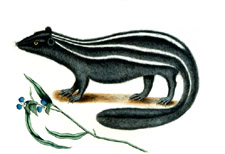
THIS in ſhape is not unlike our common Pole-Cat,
except that the noſe of this is ſomewhat longer; the colour of
all I have ſeen is black and white, though not always alike marked;
this had a liſt of white, extending from the hind part of the head,
along the ridge of the back, to the rump; with four others, two on
each ſide, running parallel with it. When one of them is
attacked by a Dog, to appear formidable it ſo changes its
uſual form, by briſtling up its hairs and contracting its
length into a round form, that it makes a very odd and terrible
 appearance. This menacing behaviour, however inſufficient to
deter its enemy, is ſeconded by a repulſe far more prevailing;
for, from ſome ſecret duct, it emits ſuch fetid effluviums,
that the atmoſphere for a large ſpace round ſhall be ſo
infected with them, that men and other animals are impatient
till they are quit of it. This ſtench is inſupportable to ſome
Dogs, and neceſſitates them to let their game eſcape : others, by
thruſting their noſes into the earth, renew their attacks till
they have killed it, but rarely care to do with ſuch noiſome game,
which, for four or five hours, diſtracts them. The Indians,
notwithſtanding, eſteem their fleſh a dainty; of which I have eat,
and found it well taſted.
I have known them brought up young, made domeſtic, and prove tame
and very active, without exerciſing that faculty, which fear
and ſelf-preſervation perhaps only prompts them to.
They hide themſelves in hollow trees and rocks, and are found
in moſt of the Northern Continent of America. Their food
is inſects and wild fruit.
appearance. This menacing behaviour, however inſufficient to
deter its enemy, is ſeconded by a repulſe far more prevailing;
for, from ſome ſecret duct, it emits ſuch fetid effluviums,
that the atmoſphere for a large ſpace round ſhall be ſo
infected with them, that men and other animals are impatient
till they are quit of it. This ſtench is inſupportable to ſome
Dogs, and neceſſitates them to let their game eſcape : others, by
thruſting their noſes into the earth, renew their attacks till
they have killed it, but rarely care to do with ſuch noiſome game,
which, for four or five hours, diſtracts them. The Indians,
notwithſtanding, eſteem their fleſh a dainty; of which I have eat,
and found it well taſted.
I have known them brought up young, made domeſtic, and prove tame
and very active, without exerciſing that faculty, which fear
and ſelf-preſervation perhaps only prompts them to.
They hide themſelves in hollow trees and rocks, and are found
in moſt of the Northern Continent of America. Their food
is inſects and wild fruit.
|
Putois.
CELUI-Ci, par ſa taille, n'est pas fort different
de nôtre Putois commun, ſi ce n'eſt que ſon nez eſt un peu plus long.
Tout ceux que j'ay vûs étoient noirs & blancs, quoi qu'ils ne fuffes pas
marqués di la même manière.
Celui-ci avoit une raye blanche, qui s'étendoit depuis le derriere de la tête
tout le leng du milieu du dos, juſqu'au croaposm, avec quatre autres rayes
de chaque côte, qui lui étoient paralleles.
Lors qu'un de ces Animaux eſt attaqué par un Chien, pour paraître plus
terrible, il change ſi fort ſa figure, en bériſſant ſon poil, & ſe
ramaſſant tout le corps, qu'il est preſque tout rond, ce que le rend étrange
& affreux en même temps; cependant cet air menaçans ne ſuffiſant pas
pour épouvanter ſon ennemi, il employe pour le repouſſer un moyen beaucoup
plus efficace; car il jette de quelques conduits ſecrets un odeur ſi
empessée, qu'il empoiſenne l'air qui l'entoure fort loin autour de lui,
ſi bien qu'hommes & animaux ont un grand empreſſement à s'en éloigner :
il y a des Chiens à que cette puanteur est insupportable, & elle les
oblige à laisser échapper leur proye :
il y en a d'autres qui, en enfençant leurs nez dans la terre,
renouvellent leurs attaques
juſqu'à ce qu'ils ayent tué le Putois;
mais rarement dans la ſuite ſe ſoucient ils de
pourſuivre un gibier ſi déſagréable,
qui les fait ſouffrir pendant quatre ou cinq heures.
Les Indiens cependant en regardent la chair comme une délicateſſe : j'en ai mangé, & l'ai trouvée de bon goût.
J'en ai vû qu'en a apprivoiſes, quand ils étoient encore
petite : ils ſont devenus doux, & fort viſs; & ils
n'exerçoient point cette faculté à laquelle
la peur & l'interêt de leur préſervation les fortent
peut-être d'avoir recours.
Les Putois ſe cachent dans le creux des arbres, & les trous des
rochers : on en trouve dans preſque tout le continent Septentrional
de l'Amérique : ils ſe nourriſſent
d'inſectes & de fruits ſauvages.
|